.png?width=195&height=70&name=image%20(58).png "image (58)")

Your Degree Matters Less Than You Think. Here's What Actually Does.
In 12 years of interviewing and hiring, I can't remember a single time the type of degree someone held made the difference between a yes and a no.
In 12 years of interviewing and hiring, I can't remember a single time the type of degree someone held made the difference between a yes and a no.
What I was always actually looking at was the person behind the résumé.
And the data is starting to back that up in a real way.
Here's what's actually happening, why it matters for you, and what to do about it.
The degree requirement is disappearing. Sort of.
➟ A 2026 Lumina Foundation-Gallup survey of 2,000 U.S. employers found that 23% had already removed degree requirements from some roles (my company has👏), with another 20% in the process of doing so.
➟ A separate 2025 Resume Templates survey of 1,000 hiring managers found that 7 in 10 said their companies now prioritize relevant experience over a bachelor's degree when making hiring decisions.
➟ However, the real-world impact falls to fewer than 1 in 700 new hires overall.
BTW... I recently launched the Job Interview Q&A Framework Guide. It has 20 questions and 20 frameworks (plus access to my AI Grader) so you can answer every interview question with clarity and confidence. Check it out below.
So what actually gets people hired and promoted?
When I'm reviewing entry-level candidates, I'm not scanning for prestige.
I'm looking at summer jobs, class projects, volunteer work, certificates.
I'm asking:
-
Is this person disciplined?
-
Do they communicate well?
-
Can they handle change without falling apart?
You don't learn those traits in school, so we need to determine if they exist in how someone describes their experience.
The research supports this.
TalentSmartEQ tested emotional intelligence alongside 33 other workplace skills across millions of employees and found that EQ is the strongest predictor of performance, accounting for 58% of job success across all types of roles.
📣 Their data also found that 90% of top performers score high in emotional intelligence, and that people with high EQ earn an average of $29,000 more per year than those with low EQ, with every additional point in EQ adding roughly $1,300 to annual salary
5 skills that move the needle regardless of your major
-
Emotional intelligence. Self-awareness, empathy, the ability to regulate your own reactions. This is the most important. It's also the most learnable.
-
Adaptability. The market is moving fast. Companies need people who don't wait to be told what to do and don't freeze when things change.
-
Communication. Written and spoken. Can you articulate an idea, give feedback, or push back without making things weird?
-
Organizational awareness. Understanding how a team or company actually works, beyond your job description. This is how you get promoted.
-
Influence without authority. Getting people to move in a direction without having a title that demands it. You can start building this right now.
Where non-technical degrees are winning
Marketing and sales need people who understand how other people think:
AI can generate copy and run A/B tests. It can't replace someone who knows how to read a room, build trust with a client, or write something that actually moves people to act.
Liberal arts, social science, communications, and psychology majors can learn the tools.
The people skills take years. And right now, companies are starting to realize that a candidate who can pick up Salesforce and bring genuine emotional intelligence to the table is ahead of many technically trained people who struggle to collaborate or communicate clearly.
The trend worth paying attention to right now
With AI changing how organizations operate, curiosity is becoming a professional differentiator.
Companies are looking for people who are exploring and adapting on their own, not waiting for a task list.
The Harvard/Burning Glass study found that among the firms making skills-based hiring work in practice, leaders like Walmart, Apple, Target, and General Motors, what they had in common was deeper systemic changes in how they source and evaluate candidates.
The window is opening. But candidates who are building real skills and demonstrating initiative are the ones walking through it.
Most of all, trust yourself.
💜 Brianne
PS: Stop guessing during interviews
Most candidates answer interview questions the same wrong way and they never find out why they didn't get the call back.
They ramble on "tell me about yourself."
They go humble on "why should we hire you."
They tank the salary question by naming a number first.
If this is you, it's not your fault. Nobody ever told you what interviewers are actually listening for.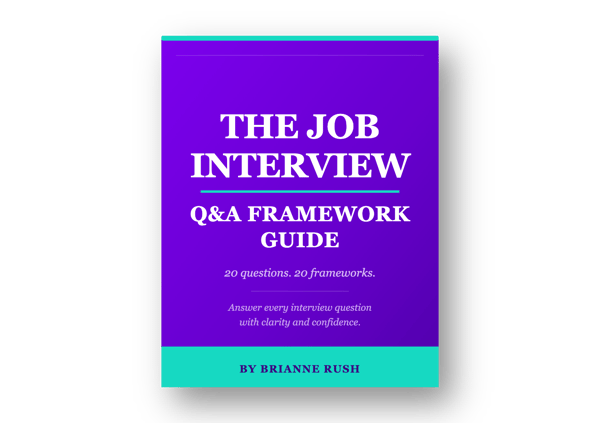
Now I am...
I've been interviewing and hiring people for the past 12 years.
I know exactly what makes a candidate land and what makes a hiring manager put the resume in the no pile.
So I created the Job Interview Q&A Framework Guide. It was 20 questions and 20 frameworks so you can answer every interview question with clarity and confidence.
It's only $15. If you land a job for $50k, that's a 333,322% return on your investment!
Get it here.
There is so much more to learn on your journey to your independent life. Check out all our articles here.

Don't have the years of experience required? Do these 5 things to get ahead

My viral post makes interviewing a little bit easier