.png?width=195&height=70&name=image%20(58).png "image (58)")

How to Get Experience When Nobody Will Hire You Without It
Since graduating from Elon University in May with a strategic communications degree, Rachel Grandis has been searching for a full-time role.
Since graduating from Elon University in May with a strategic communications degree, Rachel Grandis has been searching for a full-time role.
She created content for her school’s athletic department, managed her business school’s social accounts, completed multiple social media and marketing internships, and worked in restaurants and summer camps.
Still, none of it has turned into an offer.
“Entry-level to these companies is somebody who’s coming from three years of experience in the workforce. It’s hard when they want all this experience, but no job is willing to give you that first experience to have on your resume.”
She is not being dramatic. And the numbers say she is far from alone.
The bar moved
According to Cengage’s 2026 Graduate Employability Report:
- 77% of grads say employers want too much experience for entry-level roles.
- 75% say there are too few genuinely entry-level opportunities left.
- 53% of grads say they chose not to apply to jobs because they felt underqualified.
That is up from 48% in 2025, and it has been climbing since 2023.
Separately, Handshake data show employers posted nearly twice as many full-time jobs for the Class of 2022 as they did for the Class of 2026.
So no, it is not in your head.
You are competing for fewer openings, often against people with more experience.
But a self-rejection guarantees you never get considered.
Why the bar moved
The Wall Street Journal recently wrote about what gets lost when busy work disappears. Restructuring and AI are making entry-level work more efficient, but they are also removing some of the repetitive, low-stakes tasks where junior employees used to get practice.
Formatting the deck. Pulling the data. Drafting the first pass of an email.
We called it grunt work because it felt like grunt work.
But it was also a curriculum.
You learned the company by doing the small stuff. You got better because someone let you do the small stuff badly first.
Michael Hansen, CEO of Cengage Group, said employers “don’t have the patience anymore to train somebody in the basic skills that they might have had 10 years ago or even five years ago,” to CNBC.
Knowing the system is broken does not pay your rent. You still need a job in it.
What the silence does
Inc. recently wrote about the way a prolonged job search can crush confidence.
Career counselor Amanda Langer described what a prolonged search does: “It erodes a person’s confidence over time and their sense of agency, along with their financial security.”
It's not only that you feel bad. It's that you stop believing your actions can change the outcome.
Silence can be especially corrosive because it gives you no feedback and no clear way to improve.
The Evidence Stack
You cannot fix the market.
What you can do is stop competing only on credentials...where you may be disadvantaged against someone with three years of directly relevant experience...and start competing on evidence.
The Evidence Stack has three layers:
Layer 1: Skills, translated
Managing your business school’s social accounts is project management.
Running content for an athletic department is stakeholder management.
Coordinating a summer-camp schedule is logistics and conflict resolution under pressure.
None of that belongs only in a resume line that says “Social Media Intern.”
So here's how to write it instead:
Led content operations for a business school's social channels, owning the editorial calendar, approvals, and performance tracking across 3 platforms.
Managed stakeholder relationships for an athletic department's content program, coordinating with coaches, athletes, and communications staff to publish on deadline.
Built and ran the scheduling system for a summer camp serving 200+ kids, resolving daily conflicts between staff, parents, and activity blocks.
Each line still names the skill. Each one also shows the moment it was used.
PS: This is exactly why I built the Life Resume Template. It takes the experiences you're currently discounting and turns them into interview stories.
Layer 2: Proof, built solo
Pick one specific problem a company you want to work for has. Not "their social is bad." Something you can point to: their Instagram Reels get a fraction of the views their TikToks do. Their careers page hasn't been updated since 2023. Their launch emails never mention pricing.
Solve one small piece of it. Small enough that you can finish it in a weekend.
If you want to work in social media, take their weakest content format and rebuild it. Show three versions with your reasoning for each.
If you want to work in marketing, write a campaign brief for a launch they already announced or already ran. Real product, real audience, real timeline.
📣 Two rules: build it from what the company already published publicly, and never hand over more than they'd see in a portfolio sample.
Then send it to exactly one person: the hiring manager, the social lead, the recruiter who posted the job.
Include four sentences and one question: What problem you noticed, what you made, one line on your reasoning, and a link. Then ask something only they could answer, like "Is Reels a format you're planning to invest in this year?"
This gives them a real reason to respond.
Layer 3: Cadence, not hope
Since silence can erode your confidence, treat the search like a job you are running, not a lottery you are waiting on.
Track it.
Know your numbers:
- How many strategic applications did you send?
- How many outreach notes did you write?
- How many conversations did you start?
- What did you build?
And give yourself a weekly scorecard that measures effort, not outcomes.
Your assignment this week:
➟ Pick three experiences you have been discounting and name the skill each one proves.
➟ Choose one company, find one real problem, and build one small piece of a solution.
➟ Set your effort scorecard for this week and judge yourself against that, not against the silence.
Most of all, trust yourself.
💜 Brianne
You have more experience than you think...these resources help you frame it
1. Free Resource
Life Resume Template: build the stories that get job offers, regardless of how much experience you have
2. Interview Framework Mini Kit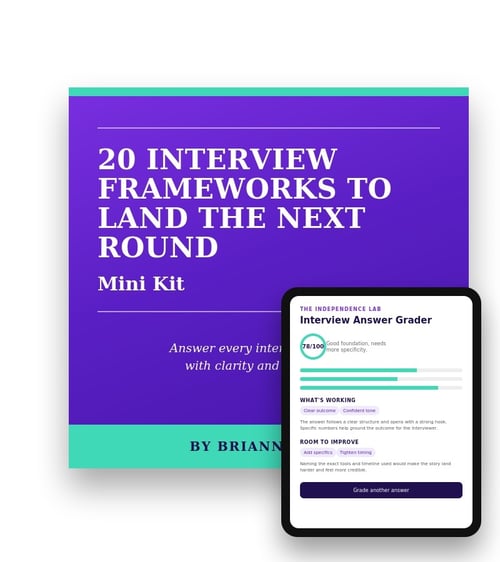
You already know the questions they're going to ask. You just don't know what to say. The Interview Frameworks to Land the Next Round Mini Kit includes 20 interview questions & 20 frameworks + the AI grader.
Get flexible frameworks to help you mold your answers to exactly what the hiring manager asks.
3. Mock Interview to Build Confidence
If you want feedback on your actual answers and communication skills, book a mock interview session. We'll run through real questions, and I'll tell you what's working and what's costing you the offer.
There is so much more to learn on your journey to your independent life. Check out all our articles here.