.png?width=195&height=70&name=image%20(58).png "image (58)")

The 5 School Habits Sabotaging Your Career
The advice most of us absorb in school is simple. Work hard. Keep your head down. Wait to be called on. Your work will speak for itself.
The advice most of us absorb in school is simple. Work hard. Keep your head down. Wait to be called on. Your work will speak for itself.
Here's what that advice produces at work: a very tired person who keeps getting passed over.
I lived it. One day, my boss walked over to my desk at 7pm, found me still grinding away, and said, "What are you doing here? Go home."
In my head, I thought I was doing exactly what I should be doing: more hours, more effort, more dedication. That's how you win, right?
Wrong. Head-down effort wasn't what moved me forward. What moved me forward was having ideas. Speaking up in meetings. Saying what I wanted out loud.
So when I went into my 6-month review, I stopped waiting for someone to hand me the next step. I said: "This is my dream. I want to be managing editor. I'm dedicated and I want this role."
I said it out loud. And I jumped over people who had been there longer than me to get the job.
That's the aha moment I want you to notice: You get promoted for making your value visible to the people who decide.
School rewards the grade, and the grade is private.
Work doesn't have grades. It has perception. If your boss can't see the impact, the impact might as well not exist. So working hard in silence isn't dedication. It's volunteering to be overlooked.
Does this mean you should become the loudest person in the room and make your boss's life miserable? No.
But you need to be influential, not invisible.
Invisible is what happens when you agree with everything and wait to be noticed. Influential is what happens when you bring your own thinking, even when it's different, and you let people see where your value lives.
People pleasers default to invisible. It feels safe. But it costs more than you think, because every time you swallow an idea to keep the peace, you trade a chance to be known for a chance to be comfortable.
Adding your own thinking is not the same as being disagreeable. When you contribute a genuine opinion in a brainstorm, you add to the pool of knowledge. Different mindsets, different views. That's the whole point of having a team.
That's what separates the people who move from the ones who stay stuck.
The 5 Habits to Flip, Starting Today
Most career advice tells you to add more. More hours, more hustle, more grind.
You don't need to add. You need to flip these 5 habits and get out of the Good Student Trap for good.
1. Ship at 70%, not 100%.
Perfectionism is the most expensive habit. In school, a flawless paper earned you the A.
At work, you rewrite. You polish. You make sure it's perfect before anyone sees it.
Meanwhile, someone else shipped a solid 70% version on Tuesday. They got feedback, made it better, and moved to the next thing. Your client is annoyed they haven't seen anything yet.
The big idea: progress compounds, polish doesn't. Ship a rough-but-clear first version and you get rounds of useful input.
If you hoard a perfect-but-private version, you get zero rounds and a reputation for being slow.
Ship at 70%. Good to go. You'll fix the rest as you learn.
2. Stop waiting to be called on.
School trained you to raise your hand and wait for permission. The teacher chooses who speaks.
Work doesn't work that way.
If you're invited to a meeting, you're at the table on purpose. That invitation is your mic.
Campbell's marketing VP Jenna Hagerich taught me this: if you're in the room, it's your responsibility to use your voice.
Share a thought. Ask the question everyone else is thinking. Offer the idea before someone else does.
The big idea: presence doesn't count unless it shows. A meeting is a potluck, not a lecture. You were invited. But you're not participating if you show up with nothing to share.
3. Trade extra credit for visible impact.
This one hurts because it feels like virtue. You take on more work. You stay later. You say yes to everything, and you tell yourself it's dedication.
But it's the fastest way to get stuck.
The school version is the extra credit assignment. Do more than asked, get noticed, get a boost. The workplace version is different: do more than asked, get more work, and get the "she does so much" label pinned to your forehead.
That label doesn't say to promote her. It says keep her where she is; she's carrying the load.
The flip: do less, but make the less matter more. Pick one high-impact project and make it undeniable. Make sure the right people see it.
The big idea: impact gets rewarded, volume gets absorbed. The person doing visible, important work on fewer things will outpace the person doing invisible busywork on everything.
4. Bring your own approval.
In school, someone was always there to grade you. The teacher handed back the A. You learned to wait for that thumbs up, and to need it.
Your manager is not tracking you down to tell you you're doing a great job. They're busy. Most of the feedback you'll ever get in your career, you'll have to create yourself.
So stop waiting for approval to arrive. Go get it. Schedule the conversation. Ask your manager, "What's one thing I could do that would make your job easier this month?"
Ask, "What would need to be true for me to be ready for the next level?"
The big idea: seeking feedback is a leadership move. Waiting for it is a passive one.
Someone who asks for one specific piece of feedback every month learns 10X faster than someone who waits for the annual review to find out they've been off track.
5. Disagree to become known.
Class projects taught you to be collaborative. Don't be difficult. Get along. This is the most dangerous of the five, because it wears the costume of being nice.
You don't have to be difficult. You just don't have to agree with everything. Agreeing with everything is what makes you forgettable.
When a decision is being made and you have a different take, that take is the single most valuable thing you can offer. You won't always be right, but that's OK. A team where everyone nods is a team with one brain. That's how bad calls get made.
So say it. Even when it's different from everyone in the room. Especially then.
The big idea: dissent is how you get read as someone who thinks, and thinking is what leaders do. The person who finally speaks up in the brainstorm with a contrarian angle is the one the room remembers.
The habits that got you here won't get you there. Flip them.
Most of all, trust yourself.
💜 Brianne
Still looking for the right role? I can help...
1. Free Resource
Life Resume Template: build the stories that get job offers, regardless of how much experience you have
2. Interview Framework Mini Kit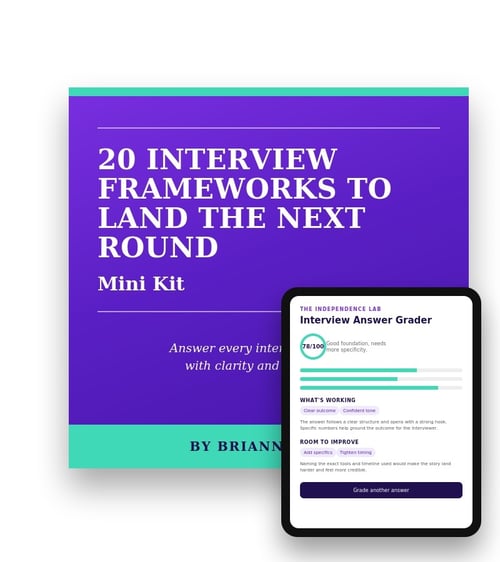
You already know the questions they're going to ask. You just don't know what to say. The Interview Frameworks to Land the Next Round Mini Kit includes 20 interview questions & 20 frameworks + the AI grader.
Get flexible frameworks to help you mold your answers to exactly what the hiring manager asks.
3. Mock Interview to Build Confidence
If you want feedback on your actual answers and communication skills, book a mock interview session. We'll run through real questions, and I'll tell you what's working and what's costing you the offer.
There is so much more to learn on your journey to your independent life. Check out all our articles here.

Don't have the years of experience required? Do these 5 things to get ahead

My viral post makes interviewing a little bit easier